Once upon a time, there was a mother and daughter who liked doing things together. One year, shortly after the daughter’s parents moved into another house, the daughter thought it’d be cool to make a housewarming quilt for them. After all, she’d made at least 10 bed-sized quilts over the years, including a scrap quilt for her folks’ mountain cabin early on, way back in 1982.
When the daughter talked to her mother about preferences regarding design and color scheme, the two of them realized this would be a fun project to take on together…
And so, we did.
Ma offered up design ideas for the King size quilt-to-be, and I found a pattern idea for the medallion section.
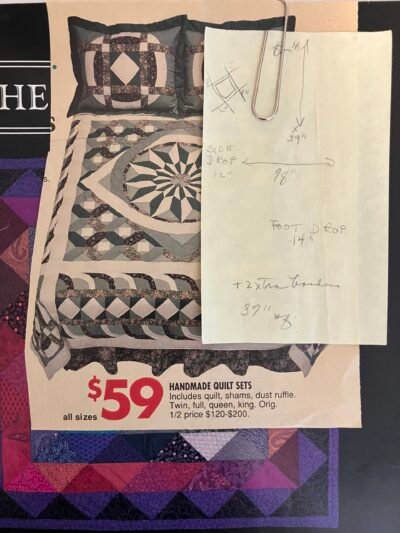
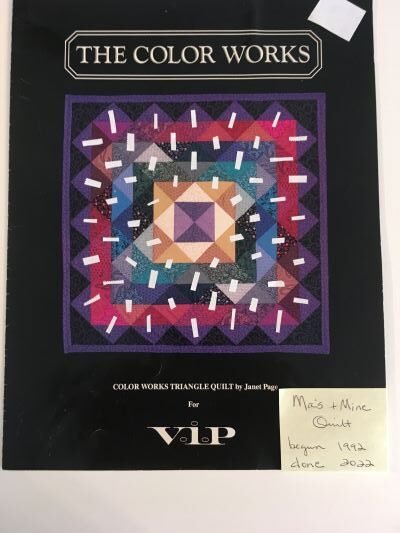
We decided to position the medallion en pointe and square it up with to-be-determined related corner designs. The resulting center square would then be surrounded with alternating pieced & solid fabric borders until it reached the required length and width for a King size quilt.
The Color Works pattern used the traditional method for creating HSTs (half-square triangles). That is where each triangle is cut individually then sewn with another to make one HST block unit. Not only is that a time-consuming method, but manipulation of the bias in the process of further construction causes inaccuracies in the completed HST block unit.
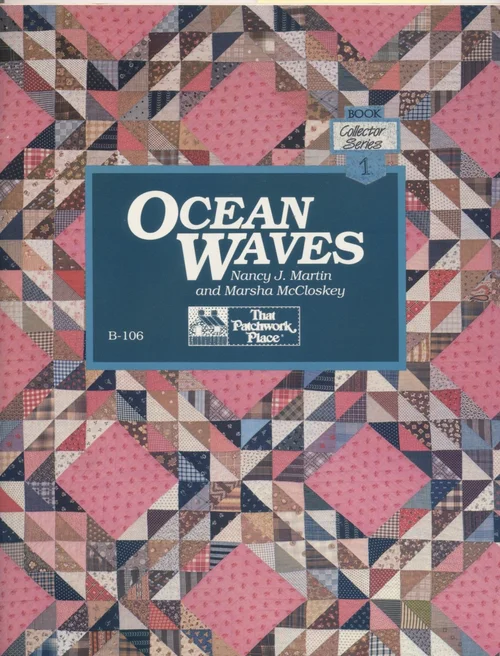
A few years earlier, I was introduced to a groundbreaking new method of HST block construction based upon rotary cutting from the quilt book, Ocean Waves by Nancy J. Martin & Marsha McCloskey. Shortly after its 1989 publication date, I plowed full steam ahead and made a Queen size scrap version of that quilt***, relying heavily on my knowledge of using value as a means to make sense of multi-colored scrappy scraps.
Using this new-at-the-time bias strip piecing method solved the bias distortion problem. The bias strips are cut, sewn together on the bias edge, then cut into individual HST block units. That leaves the outer edges on the stable grain of the fabric with the bias contained and safe from excessive manipulation. A demo of this method can be viewed here.
Design and method determined, now came the fun part. Gathering fabrics. And…teaching Ma how to use the rotary cutter! A quick learner, we spent snippets of time together and separately dutifully cutting out hordes of bias strips.
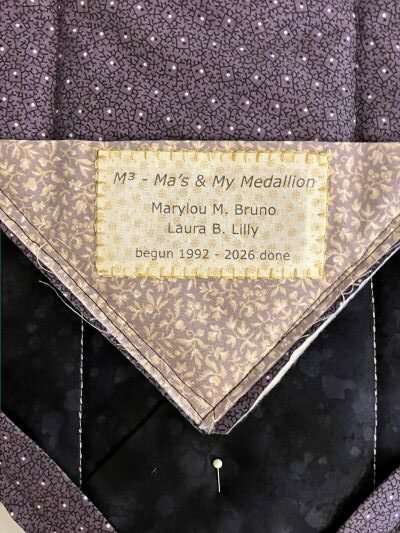
Here then, is where part 1 ends. I’m wondering: did any of you, my dear readers, discover when this project began? If so, then did anyone further notice the length of time it took to complete? Hint: clues can be found in the featured image.
Let me know in the comments below and stay tuned for part 2!
*Sales advert from some department store – 1990s pricing on poorly stitched imported handmade quilt sets made with cheap quality fabrics, all sizes.
**The VIP Color Works Collection Triangle Quilt/Wallhanging by Janet Page for VIP. Pattern instructions such as these were displayed alongside bolts of new fabric collections and free for the taking. None of the fabrics from this specific collection were used in M³.
*** Photos of it are buried deep in a box somewhere. 🙁