The road ends, but the journey continues...

Category: Musical Musings (Page 4 of 12)

Shortest Day, Longest Night

“The light shines in the darkness and the darkness has not overcome it.” – John 1:5

These past few years I’ve been heavy on the ‘longest night’ part of reflecting upon life’s unfolding during the winter solstice. So herein I am pondering more of the ‘shortest day’ side of things.

I like sitting this side of the solstice – winter’s frozen heartbeat on the cusp of a new beginning. Almost but not quite on the other side of darkness.

Bright spots. Glimmers. Slanting, lingering glow-rays.

Those are the things any day can bring – and are especially darkness busting on The Shortest Day.

Offerings I grasp onto, hoping to not miss any scrap of sunshine put out there to encourage me along the way through.

This year’s ‘shortest day’ forced its way into my brain. Insisting I pause, recognize and think on the myriad kaleidoscope bright spots, glimmers and slanting glow-rays of MMXXI.

From getting vaxxed, which enabled something as simple as getting a haircut and grabbing my first coffee at the new shop in town, to meeting up with a quilter-blogger buddy for the first time face-to-face at her home (and fantastic quilting studio) in NC. Plus numerous road trips made to Michigan and Chicago…mostly for fun, family gatherings, but also one that included sharing the grief with family due to the passing of my Aunt Adua.

In many cases, what was interrupted by 2020’s COVID crisis began to re-start this year in different ways…for our son that meant ‘how to get engaged, married and go on a honeymoon’ during a Pandemic. The beginning of the Pandemic caught him and his girlfriend hiking the Patagonia wilderness – a miracle story in and of itself of how they even got back on American soil…They are now honeymooning in Thailand.

🙂

In conclusion (!), the following just seems to put ‘the shortest day’ and ‘the longest night’ into a sort of musical representation of what I’m trying to convey in this winter solstice pondering – give it a listen.
A Boy And His Tuba

Dear Kaden,

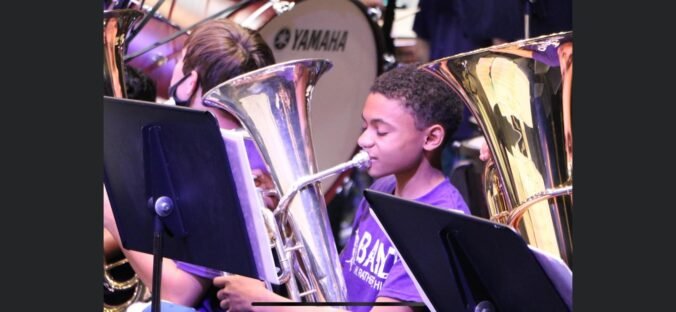
Your Ma texted me some pictures and a video she took of you playing at your most recent concert. You sat tall and straight and played your part well – without tapping your foot – yes, I noticed! Good job.

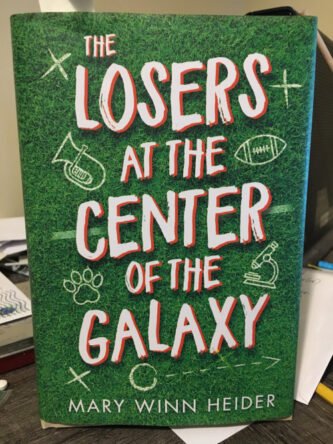
A few weeks ago, I won this book for you. I read an interview a writer friend of mine had with the author, Mary Winn Heider, about her newly released book, “The Losers at the Center of the Galaxy”. Learning that one of the main characters was a boy whose best friend was his tuba – I knew I had to enter the contest and try to win this book for you! And I did!

I waited to send it on to you because I wanted to read it, too. Your Ma might like that it has references to Chicago (our shared hometown – we’re cousins, you know). I suspect the football team and stadium described in the book is based upon Northwestern University in Evanston, but it’s still fun to have that Chicago connection along with the tuba connection.

One of Winston’s (the tuba player in the book) favorite pieces to play is Darth Vader’s Theme from Star Wars – The Imperial March. So, I printed out a copy for you. Who knows, you might play it in a concert next year?

I found a very short 1-minute YouTube of a student about your age practicing playing it on the sousaphone. Which as you probably already know is the marching band version of a tuba. You might like to see it here.

I also am sending you a link to the author’s book trailer. This is a very short 1-minute Vimeo video where she talks about her book and shows you how she works out her action sequences – very fun!  

I am proud of you Kaden. Keep playing your tuba – it is way cool.

Lots of love & hugs (I get to say that because we’re cousins, too!),

Laura


Thanks to all you music teachers in the schools – you serve as first introducers to the glorious variety of instruments there are in this world to try out and play. And a huge thank-you to L. Marie – you help connect kids with books and readers with authors.


Resources for inspiring aspiring Tuba Players

Losers at the Center of the Universe book cover
  • Let’s start off with this book. It can be found here, here and here.
  • Free sheet music of arrangements of popular tunes for tuba at various proficiency levels by TubaPeter can be found here.
  • Your local Tuba Player Musician/Teacher (ask your music shop or school band teacher for recommendations).

Giving Voice: The 8th Wonder of The World…

…Stevie Wonder.

On the many wonders of this world…

“There are more than 7 wonders of the world – he (Stevie Wonder) is #8.”

Angelo Roman

Innervisions – Stevie Wonder

One of my favorite albums during my college years (1972-1977). Here’s a studio clip on recording ‘Living for the City’ which is as fresh and (unfortunately) relevant to today’s issues as it was then… all (he)artistically mastered by a master. What follows is the whole song as recorded on Innervisions.

For a touch of relief in this world of many troubles and plenty of social injustices I end this with Stevie’s “Don’t You Worry About A Thing” on this same album, Innervisions.

Thank you, Stevie.

Carolan’s Concerto

Background

Turlough O’Carolan.

Most Celtic music enthusiasts and instrumentalists are familiar with this man’s body of work and prominence of place within the Irish folk tradition.

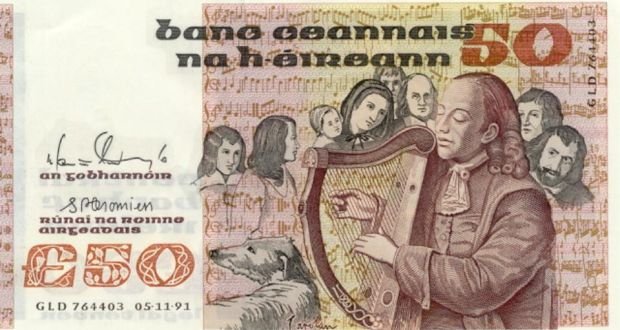
Turlough O'Carolan on Irish 50 pound note

Long credited as being Ireland’s national composer, Turlough was born in 1670 and lived during the Baroque Era* of Western musical history. That Baroque reference is important to note. While traveling the lands of the Emerald Isle as an itinerant harper, he was in fact a contemporary of Scarlatti, Geminiani and Corelli – all composers of varying prominence of the day.

Put another way: Turlough O’Carolan could be called the Baroque Bard of Ireland.

My off-the-cuff quip notwithstanding, a rich mingling of musical traditions is indeed the basis of Carolan’s Concerto.

“In Carolan’s time, there were three musical traditions in Ireland – art music, folk music, and the harper tradition. The harper tradition served as a link between art and folk music and was the main conduit for the oral tradition. Carolan created a unique style by combining these art forms, and then adding elements inspired by Italian music which was then fashionable in Ireland. He was a great admirer of Vivaldi and Corelli, whose modern music he would have heard in the homes of his noble Irish patrons, and this admiration is reflected in the melodic construction and forms of many of his pieces. In fact, it’s said that his Carolan’s Concerto was a winning response to a compositional challenge from Geminiani, an acquaintance, colleague, and contemporary.”

Bridget Haggerty, Tribute to Turlough

My Take

Shortly before the beginning of the infamous New Year of 2020, I earnestly tackled composing an arrangement of this piece.

I wanted to adapt it for solo classical guitar in like forever and was pleasantly amazed at how it came together so quickly. I even produced two possible endings and put them up for a vote with my son and son-in-law – both musicians.

Consensus: First ending.

My take on Carolan’s Concerto was proving to be a breath of fresh air and loads of fun.


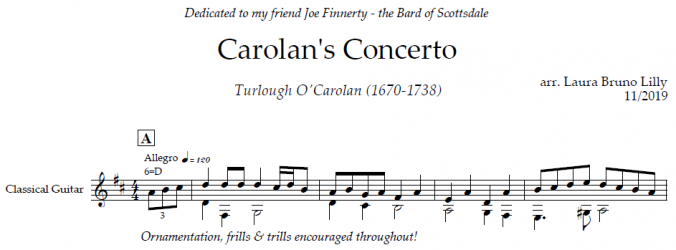
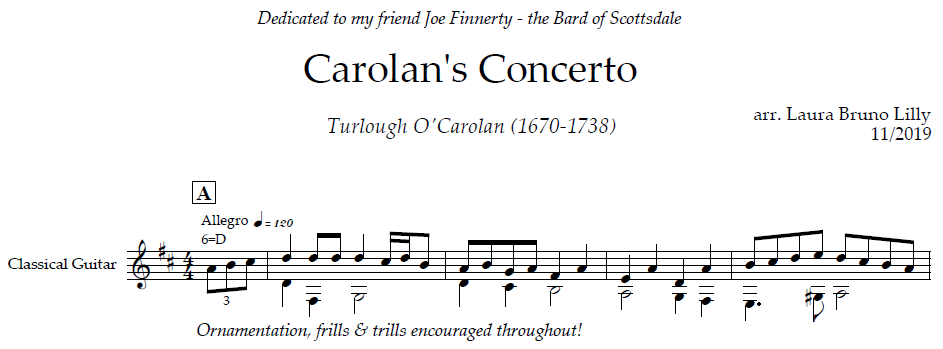
Carolan's Concerto excerpt
score excerpt ©2020 LBL/Purple Tulip Music

Within weeks of that previously mentioned infamous New Year of 2020, I started serious practice of my new arrangement.

General impression: It is good. It is a completed piece.


Carolan’s Concerto – arr. for solo classical guitar by Laura Bruno Lilly ©2020
(NOTION score computer playback)

A computer generated playback of my arrangement of the Celtic tune Carolan’s Concerto, written by the blind Irish Bard – harpist, troubadour and composer – Turlough O’Carolan (1670-1738).


It was also too fast for me to play a tempo.

Discouraged, I set it aside.

Until a few weeks ago. That’s when I pulled it out for a re-look and when the ‘obvious’ hit me.

Why not play it anyway? Who says it has to be performed at such a scathing tempo?

Besides, the traditional tempo set for that piece is also traditionally variable.

A lively rendition of Carolan’s Concerto played ‘a tempo’

Here’s the thing:

Not every guitarist is a shredder, lightening fast player. Plus, my arrangement is not a single line ‘solo’ that can be easily ‘shredded’!

Even after properly practicing certain passages of the piece at slower tempos and then speeding them up incrementally I may never get it up to the tempo as played in the above video.

So what?

Play it. Just. Play it.

“Some players are simply faster than others, the way some athletes are faster, bigger, stronger, etc. Still, none of that means ‘better.’ So, find your own performance tempo, and then bring more of yourself to the piece. Remember, you possess your own sound, tone, phrasing, attack, texture, etc. If you highlight those qualities, I promise you, no one will ever complain about the tempo.”

Shawn Persinger, Wood & Steel magazine, vol 99, Issue 1, 2021

*period or style of Western art music composed from ~1600-1750. A good synopsis of the times, characteristics and elements of the music can be found here.

The ‘3 Measure Fix’

Sometimes all it takes is a 3 measure fix.

This vaguely simplistic concept was brought to light a few days ago while staring down an old (as in a piece I put aside years ago to work on ‘later’) arrangement I began, but never finished, for solo classical guitar. Something about it wasn’t quite right back then and something about it still wasn’t quite right, right now.

There were these 3 measures that, well, just didn’t measure up.

In seeing what I’d done previously with fresh eyes, I couldn’t dismiss it as a throw-away. I’d already invested much time and effort into crafting an original arrangement of a traditional Tarantella. It was, in truth, almost finished.

Stylistically, there are many songs in Italy that qualify as a Tarantella – basically a rowdy, raucous dance tune with moves inspired by – you guessed it – the Tarantula. More specifically, ridding one’s self of one and/or what happens after one gets bitten by one (frenzied madness)!

As is typical in folk music, each town, province, heck – family – has their own version of this. I mention family because coming from a musical family, these things get passed down along with the traditional family recipes. But not necessarily in tangible, written down form.

I knew how to play it in ensemble. That’s just a fancy way of saying I could rock out those rhythmic chords on my 12-string acoustic and/or classical guitar to my Dad’s clarinet/saxophone or my former duo partner’s violin/mandolin melody instruments.

But I really wanted it in my personal arsenal of songs to play for fun in a solo classical guitar context.

That said, I knew how my arrangement needed to sound.

I sight-read the unfinished score on my music stand with its errant 3 measures standing out as ugly as ever. Searching for a solution, I reviewed the source materials referenced in the initial creation of the arrangement and noticed something tucked in between the pages of my notes. All those years ago, I had hand-written a 3 measure idea to insert as a possible replacement for the trouble spot.

Sometimes all it takes is a 3 measure fix.

My ‘fix’.

Hmm, why hadn’t I just gone with that in the first place?


This video offers a good example of a player working through various ideas for an arrangement of the most recognizable of all Tarantellas.

Bye, Bye, MMXX

vonnegut quote

It’s been a hard year.

To borrow the March proverb and apply it to our domestic and worldwide on-going state of affairs, I like to think that as 2021 ‘comes in like a lion’ it will ‘go out like a lamb.’

In the meantime –

I believe in kindness. Also in mischief. Also in singing, especially when singing is not necessarily prescribed.

Mary Oliver

This 2020 virtual choir video edition of How Can I Keep from Singing makes me feel less alone – its message, its virtual human presence. It seems just what the doctor ordered to usher in a dose of courage, strength and continued commitment to stay the course during these unrelenting times.

Being raised Catholic, and then doing the Jesus People street theatre scene in the 70s, my knowledge of purely Protestant Hymns is limited. Yet, here in the midst of a 21st century Pandemic, it took a Unitarian quilter blogger buddy to introduce me to this encouraging and joyful Hymn (thank-you, Zippy).

My life flows on in endless song above earth’s lamentation.
I hear the real, though far-off hymn that hails a new creation.
No storm can shake my inmost calm, while to that rock, I’m clinging. Since love prevails in heaven and earth,
How can I keep from singing?

– Keep singing –

Thoughts Thought on The Longest Night MMXX

Can a 66 year-old woman begin her own designated Hero’s Journey? Again? Is it too late? Rather, is there time left in her life to dive into yet another Path that would surely reveal itself during that Journey?

In many ways, 2020 has been the dead-end to end the multiple dead-ends I’ve hit over the past few years in my creative life. One could say it has been the ending of an unconscious Hero’s Journey.

My generation has always championed the idea of jumping over one’s shadow. Elements of a traditional “Hero’s Journey” are hardwired into my everyday life. In fact, they were supported and modeled by my folks even as my life took shape. So, facing more adventures, twisty, turny changes, and making do are all just part of the mix. Mostly, knowing that in the midst of it all, surviving & thriving are not mutually exclusive and is a precious insight.

Somewhere along my (he)artist’s way, product and validation overtook process and creation. As such, the muse all but disappeared, the gift all but withered.

The focus to finish and get my project(s) ‘out there’ became so strong it obscured seedlings of exploration, experimentation and self-expression. And in the end, with little to show for that absorbing focus.

The good part to all of this is that the stubborn ruts I’d traveled were more easily seen for what they were – not an obstacle to the Path, but proof that I’d wandered from the Path.

So I have corrected my focus. I am firmly ensconced in choosing repertoire based upon pure desire to play/perfect what I want to play – not based upon some audience type or proficiency parameter. And the composing! Instead of keeping it in check so as not to overshadow my practice time and/or exploration of tangential instruments, I am fully leaning into those juicy sessions.

Yes, I have project(s) that are screaming to be ‘out there’. Many are in fact 99.9% ready to go…but I gave myself permission to just not angst over all the odds and ends I’m clearly not knowledgeable enough to do right now to finish them*.

In other words, I gave myself permission to do what I was meant to do: create music – play around with sound – and commune with the Giver of the Gift in doing so.


Meanwhile, this year marked the entry into one of my favorite type of birthdays – one of duplicate double digits. It’s just one of my things.

The last such marker was 5-5 Revive.

Surprisingly, this year’s spontaneously spoke forth as Route 6-6.

What? Taking to the road again, in this time of lock downs, life threatening environmental obstacles and lack of connection?

Yep. Maybe not literally, but certainly in allowing the muse, my music, to lead the way…instead of my dragging it along with me. Be the conduit, serve the Gift and enjoy the process.

If I am the only one to hear or see or understand what comes forth, then so be it.

But I’m willing to bet this ‘Hero’s Journey’ change in attitude might alter that solo scenario come 2021.


*That’s the extreme down side of all this DIY stuff that goes along with being an Indie (he)artist – having to do all the business stuff, packaging, marketing, registering, licensing, publishing, etc; and finding/hiring qualified people to do the production side of things. It simply is not as easily available as one would think. Not whining, just sayin’…

Open Letter (debut)

Dear Teacher,
You were my very first formal classical guitar instructor…


Thus begins an open letter I wrote years ago.

The new vistas that surfing the ‘net* opened up in the ’90s prompted me to try contacting my first classical guitar teacher to thank her for the role she played in my development as a musician. I posted a copy of my open letter on both** of the forums I was subscribed to at the time in the hopes it would yield a lead towards finding her. As was common in those days, this inadvertently started a new thread on each of those forums…that of honoring those teachers who most influenced the direction of our lives.

However, it did not bring about the desired outcome.

I did not find her.

But I can still honor her***.


I have always wanted to thank-you for all you did to nurture my first forays into the world of classical guitar. I think you’d be proud of me. Not because I am anyone famous or great, but because you’d recognize the method of love I use in teaching others about our common bond: the classical guitar...


*a term bandied about along with riding the internet highway in the earlier days of internet development.

**The original ClassicalGuitarList and the LuteList are both going strong after all these years…

***Please find & read my Open Letter page neatly nestled between the PTM and DMW pages on the menu bar as part of my newly revised website.

G Squared: Gregory & Gavin

– continuing with the musical pokes and prods – re: “…David Olney lead to Gregory Alan Isakov who lead to Gavin Luke” –

After a trip down snowy Raton Pass memories, my musical (re)search landed me at the merging of a folk/classical piece performed by the Colorado Symphony Orchestra in conjunction with contemporary folk-pop artist, Gregory Alan Isakov. Thus introducing me to a new-to-me younger generation of folkies.

Note: the YouTube featured here is the only media readily available on-line with the CSO/GAI arrangement-performance of this piece. That said, watching it isn’t as important as just listening to this IMHO.

Isakov’s The Stable Song, as performed with the CSO is the type of musical collaboration that excites me as a musician.

Performing in and composing for mixed ensembles has been and continues to be one of my deepest passions as a working musician. Back in the day, it was more unusual for instrumentalists of differing genres to play together in performance or to hear ensembles of unlikely instrumentation in concert outside the University music department recital setting.

It appears these types of cross-over collaborations are becoming more mainstream* – to the delight of musicians and audiences alike.
But that has always been my bent. And upon my life’s reflection, I’m thinking I was perhaps even born into it.

My Dad as a professional jazzman on sax and clarinet was always up for a jam session with me, his daughter, on 12-string acoustic and/or classical guitar. For awhile there we even made the rounds in small performance circles as 3D: Dad Daughter Duo. Our set list comprised of standards, show tunes, contemporary pop, Latin, country, classical repertoire – you name it – with my classical guitar solos and/or 12-string acoustic folkie riffs alternating with his show stopping improvised tenor sax and/or clarinet solos dancing rings around my chordal vamps…Yeah I was born into this.

Finding that sweet-spot key where the natural intonation of disparate instruments sound good while playing together is a greatly rewarding endeavor.
I find it deeply satisfying, stretching the sonic boundaries via unconventional instrumentation and encountering others who explore that same territory in myriad ways.

Included with that exploration is my fascination with anything related to ‘prepared’ instruments. A technique I first encountered during my music school days, John Cage‘s forays into this altered soundscape has since given birth to a wide range of instrument manipulation in the name of New Music. Again, there is cutting edge and then there is what is palatable for mainstream.

Enter Gavin Luke, composer. More of a New Age pianist/composer, I stumbled onto his piece, In Search of Home, while perusing a composer website. The main theme of his piece is compelling, but what I found most interesting was the simple use of felt sheets in his ‘prepared’ piano as central to his composition.

Note: the YouTube featured here is a short 2.5 minutes long in which Gavin demonstrates his process in the creation of this piece.


While I appreciate the creative process as shared by compadre (he)artists regardless of genres, the take-away for me in this case was a surprising appearance of my poetic muse…

to be shared at another time
😎

*In order to keep this post shorter and to my intended points, I did not go into depth on the well-known, well-received and highly successful collaborations between unlikely genres & musicians over the years such as The Beatles & orchestral musicians/eastern instruments just to name one example.

« Older posts Newer posts »

© 2026 Laura Bruno Lilly

Theme by Anders NorenUp ↑