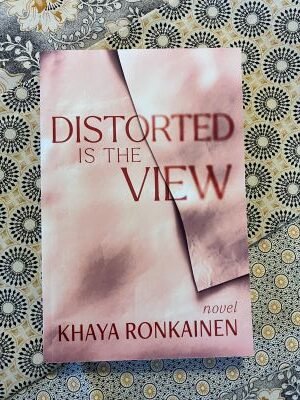

Khaya Ronkainen was born and grew up in the Eastern Cape, South Africa, and spent much of her adult life in Johannesburg. She now lives in Finland. Her work is largely inspired by nature and place, often examining the duality of an immigrant life. Ronkainen is the author of three poetry collections. Distorted is the View is her first novel. Find her work at Amazon. To learn more or connect with her, visit her blog.
I know Khaya as Poet.
“Poets use words very differently from let’s say, critics, or from novelists who use words in a logical sense. Poets are much more involved with intuition and wild flights of fancy, and much, much closer to painters.” Elaine de Kooning, abstract expressionist artist
Distorted is The View introduces Khaya as Novelist.
Brief synopsis – Sheena and George Klaasen live their lives apart during the week, each moving in directions the other cannot fully see. Their daughter, Sam, is the hinge between them…What she perceives is unsettling: shadows of secrets, words unspoken, and a quiet fracture running through the family.
Distorted is the View, back cover
Setting – South Africa in the beginning of the ‘New’ South Africa after apartheid.
While the family dynamics, conflicts and evolving relationships within this novel are relatable across countries, cultures and societies, the issues encountered by the Klaasen family are infused with the unique properties of ‘place’.
Setting & character are the primary drivers of this novel. Plot and thematic material unfold through the everyday interactions of characters within and without the local community all flavored with deep rooted, yet nuanced, South African culture.
Khaya deftly weaves the feel, the pace, the coexistence of the ‘gentle and profound’* of the complex society in which her characters live and breathe.
…Krause gave a short laugh. “He thought I was drunk as usual. He couldn’t imagine why I’d choose to settle ‘with the natives’ while the government was busy building its idea of South Africa.”
Sheena leaned back, letting the ugliness of it hang in the air without comment.
And then there is Khaya’s voice, her poetic pacing. The underlying rhythm – unrushed but always beating, moving. I found myself reading the novel slowly – ‘not because the story was difficult’* – but because it was filled with luscious poetic prose and finely crafted phrases.
the storm found its twin indoors
her skin color entered the room
her body remembered
the building swallowed the sound
All seriousness aside, one of my favorite scenes begins with an invitation received by Sheena – delivered by Sam and sent by her teacher, Precious Dlamini.
Invitation
Masakhane**. Saturday at three. Skumpa** and Laughter!
(Sheena) was drawn not to the promise of sparkling wine, but to the possibility of an alternate support system; women building each other up, as the name of the club suggested…The invitation offered her breathing room, spending an afternoon with other women who were trying to stay sane in the middle of nowhere.
The teachers were in a celebratory mood, ready for the end of the school term…At Masakhane no one asked about Sheena’s husband or her children. They didn’t pry, yet their stories folded into hers without effort…The talk was frank but light, full of knowing humour…Their candor felt intoxicating…even without touching skumpa…
Sometime during the Masakhane, a young teacher ‘placed an LP on a record player’ to practice her dance moves. Soon everyone joined her in dancing to Mama Tembu’s Wedding. Take a listen and see if it doesn’t make you want to practice your own dance moves!
The way in which this story is told, in tandem with the story itself, is what carries the reader from the very first page through to the end of the book. The delivery system, the style, the nuances, the poetic pacing are pure Khaya.
Purely African. Purely human. Purely felt.
Note: fabrics in book cover photo are traditional South African isishweshwe cloth in contemporary colorways – a featured conversational topic amongst the women at Masakhane.
*from a review by Michelle at Intimately Worded
**definitions – Masakhane roughly translates to ‘We build together’ in isiZulu; the term Skumpa, derived from Nordic/European slang, refers to local South African sparkling wine made using the traditional Champagne method.
Thank you for this introduction to Khaya’s work.
I remember once you? me? we? referred to Linda as an ‘enabler’. I think that applies equally to you 🙂
…I think that would be a ‘we’… 🙂
And I appreciate your kind kudos!
Laura, thank you for introducing us to Khaya’s work. It is good to be exposed to contemporary arts and literature from many cultures.
You’re very welcome, Cheryl. Good to hear from you – take care.
This sounds like such a fascinating novel, Laura. I like novels where I stop and reread phrases because of the beautiful language.
If memory serves, the classic ‘Cry the Beloved Country’ is another such novel where I savored phrases. Hmmm, maybe a re-read is in order?
I remember reading that when I was in high school (not for a class), but I don’t really remember it. There have been more recent books that I’ve stopped to reread phrases, but I can’t tell you what they are now! 😊
Wow! “Her skin color entered the room”, that amazing phrasing of words is an experience I’ve had many times in my life. South Africa to Finland – what an epic change. Her work is amazing!
Your personal connection to that amazing phrase is profound and powerful, Tierney. Khaya speaks truth with poetic grace.
“I’m reading it slowly, not because it’s hard . . .” Some books just need to be read slow, and I can see from your post the reason why you needed to soak in this story. Fascinating. Thanks for sharing.
My pleasure. Take care.
Excellent review, Laura! “her skin color entered the room”–Wow! That line will stay with me … probably forever. Khaya’s novel sounds so intriguing and timely. I like it when poets write novels; their way with words can add such depth and meaning to a plot and characterization.
That is my #1 favorite phrase, also. Timely, yes…..
That sounds interesting. Thanks for sharing!
You’re welcome and thanks for stopping by. Khaya’s review has been top priority for me to finish and post. And now it’s done! A ‘finish’ if you will. Another ‘finish’ post is just around the corner ready to be pubbed that might be of interest to you – Just a teeny hint of what’s to come! 😉
Laura, this sounds multilayered. How did you come to hear about Khaya’s work? I love the explanation of how poets use words. Khaya’s novel seems very lyrical. I enjoyed the song!
Yes, it is multilayered. Yet, it reads ‘light’ and realistic not heavy, deep or ponderous. That’s an abstract slice of Khaya’s style…and perhaps part of the poet perspective?
I don’t remember how I came about Khaya’s work – very likely an online poem or essay I stumbled upon. I’ve been a follower of hers for years, but the ‘how’ of how I found her initially eludes me now that you asked!